The UNESCO effect: What World Heritage Status really means to travellers
Every year, millions of travellers visit UNESCO World Heritage Sites, with Europe home to many great sites ranging from whole cities such as Venice in Italy to Canterbury Cathedral, which can be enjoyed on a UK holiday. But how many travellers truly understand the significance of these sites?
)
Indulge your love of travel
Be the first to get exclusive early discounts, the latest news and travel inspiration. Unsubscribe anytime. Privacy policy
To find out, research conducted on behalf of Saga Holidays set out to understand Britons’ perceptions of UNESCO World Heritage Sites.
We also spoke to Professor Mike Robinson, Vice-Chair and Non-Executive Director for Culture and Heritage at UNESCO, and Dr Catherine Roberts, Lecturer in Creative and Cultural Industries at The University of Manchester, to provide expert insights and advice for responsible travellers.
What does UNESCO World Heritage Status mean?
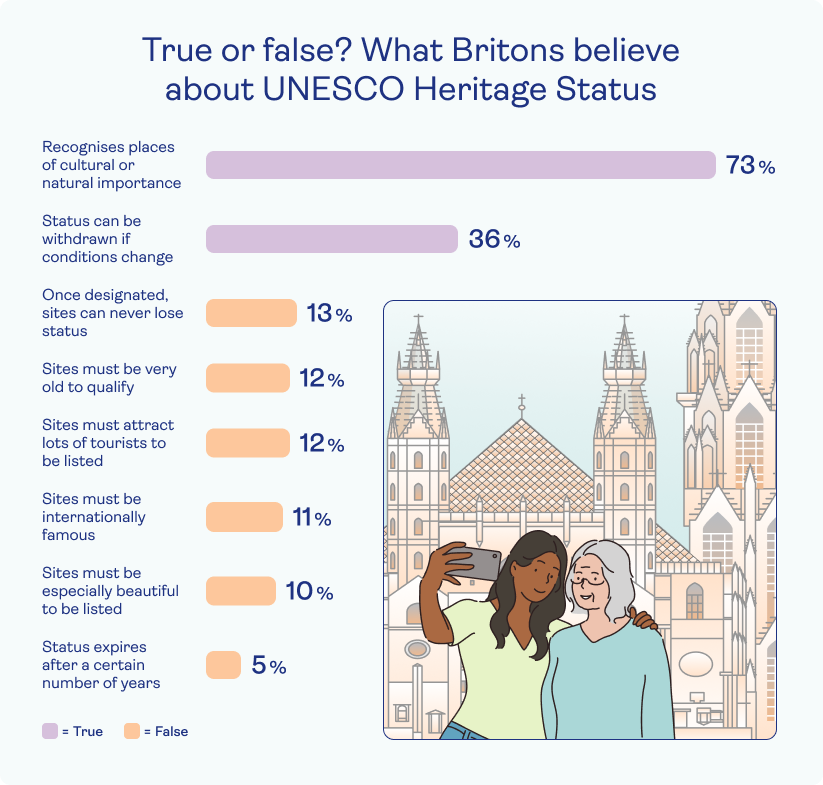
At its core, UNESCO World Heritage status recognises places that hold exceptional importance for culture, history, science or the natural world. UNESCO defines these sites through the idea of Outstanding Universal Value.
According to Professor Mike Robinson, “People often think World Heritage status is simply about fame or popularity, but that’s not really what it means. A UNESCO World Heritage Site is recognised for its outstanding universal value – in other words, because it is considered so valuable to humanity that it deserves special protection.”
Our survey found that while general understanding around UNESCO sites is relatively high, there are still some common myths shaping British travellers’ perceptions.
13% believe a site can never lose its status, while 12% believe sites must attract a lot of tourists or be very old to qualify. 11% believe sites must be internationally famous, and one in ten believe a site must be especially beautiful to be listed.
Professor Robinson commented on some of these misunderstandings:
13% believe a site can never lose its status
“It is very rare for a site to be removed from the World Heritage List. The whole point of inscription is long-term protection, and countries are given opportunities to address problems if a site comes under threat. However, some sites, like Liverpool or Dresden, have had their status removed after changes were considered to compromise the outstanding universal value for which they were originally inscribed.”
12% believe sites must attract a lot of tourists, and 11% believe sites must be internationally famous
“One of the biggest misunderstandings is that World Heritage Sites are just the world’s most famous landmarks. In reality, many sites are on the list not because they’re the most visited, but because they have exceptional significance and, in some cases, have needed protection.”
12% believe sites must be very old
“There’s a perception that a World Heritage Site has to be ancient, archaeological or very old, but that isn’t the case. What matters is not age alone, but significance – whether in terms of design, function, history or wider cultural value.”
10% believe a site must be especially beautiful
“We need to recognise that World Heritage isn’t only about grand, instantly recognisable landmarks. There are many modern and lesser-known sites that are just as important, and in some cases they may be even more in need of protection because people don’t immediately see their value.”
Are Britons more likely to visit a destination with UNESCO status?
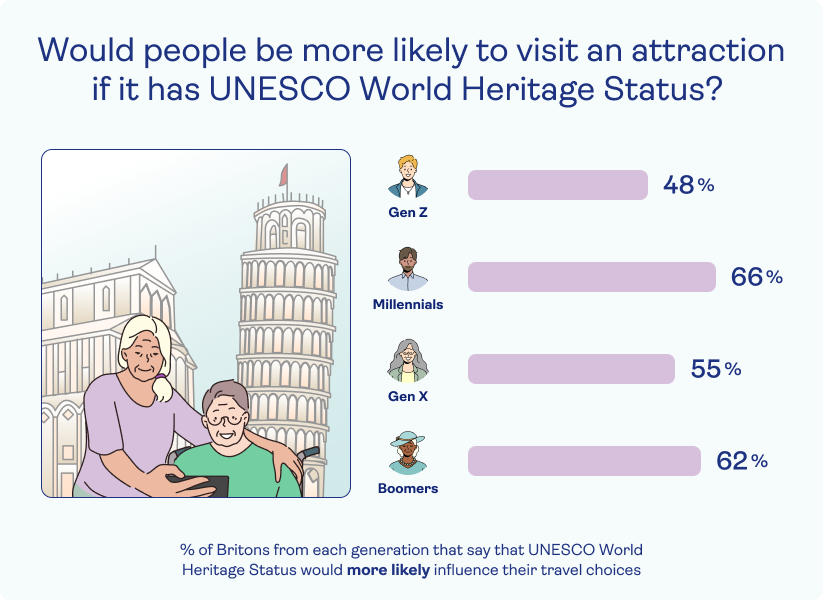
Our survey found that UNESCO status makes a destination more appealing across every generation. Two thirds of Millennials (66%) say they would be much or slightly more likely to visit a place because of its UNESCO designation, followed by 63% of Baby Boomers, 54% of Gen X and 48% of Gen Z.
However, as Dr Catherine Roberts remarks, travellers should be mindful of when they visit different sites:
“Tourism is very seasonal. Research shows this puts pressure on local communities, with over-tourism overwhelming spaces and services at peak periods but leaving local economies struggling for the rest of the year. The careful traveller will often have a more enjoyable and distinctive experience by learning about and avoiding peak times. In this way, tourists can help support more manageable year-round service provision, local employment and lower levels of stress on the environment.”
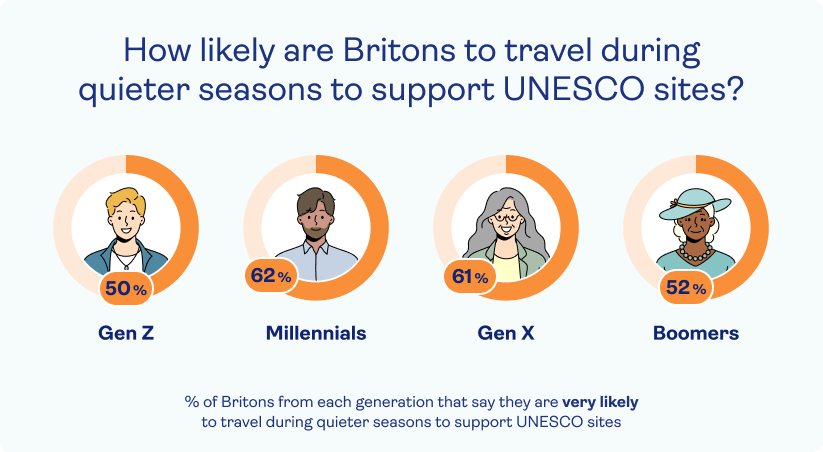
Most survey respondents say they are willing to travel during quieter seasons to support UNESCO sites and reduce seasonal pressure. Millennials (62%) and Gen X (61%) were most likely to do so, followed by 52% of Baby Boomers and 50% of Gen Z.
Understanding traveller behaviour at UNESCO Sites
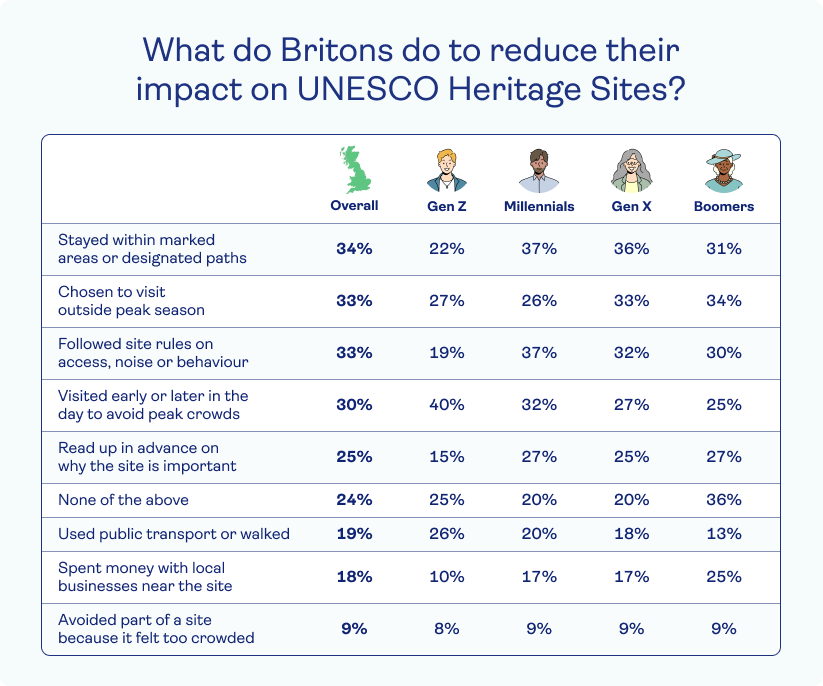
When we asked respondents what actions they currently take to protect sites they visit, the most popular answers were to stay within designated areas (34%), visiting outside of peak season (33%), following site restrictions (33%) and visiting at different times of the day to avoid peak crowds (30%). Almost a quarter of Britons do not take any steps at all to reduce their impact on sites.
Dr Roberts suggests that changing attitudes towards travel and ‘viral’ destinations could be a root cause of this:
“One of the biggest concerns around fast-paced developments in travel and technology is sheer scale – the impact of growing tourist communities in places not constructed or prepared for these visitor numbers. What follows is a difference in approach, where some tourists are not mindful of cultural sensitivity – motivated by curiosity, notoriety or simply FOMO, visitors see the spectacle and not the significance. This can make us unaware of our own impact or the perception of others, and that is what we call the ‘tourist gaze’ – a perspective that can be individualistic rather than socially sensitive or empathetic.”
The importance of research when visiting a UNESCO World Heritage Site
With the majority of Britons drawn to visiting UNESCO sites, both Dr Roberts and Professor Robinson highlight the importance of researching each destination before visiting. However, our survey finds that only a small proportion of Britons always research a site before they visit.
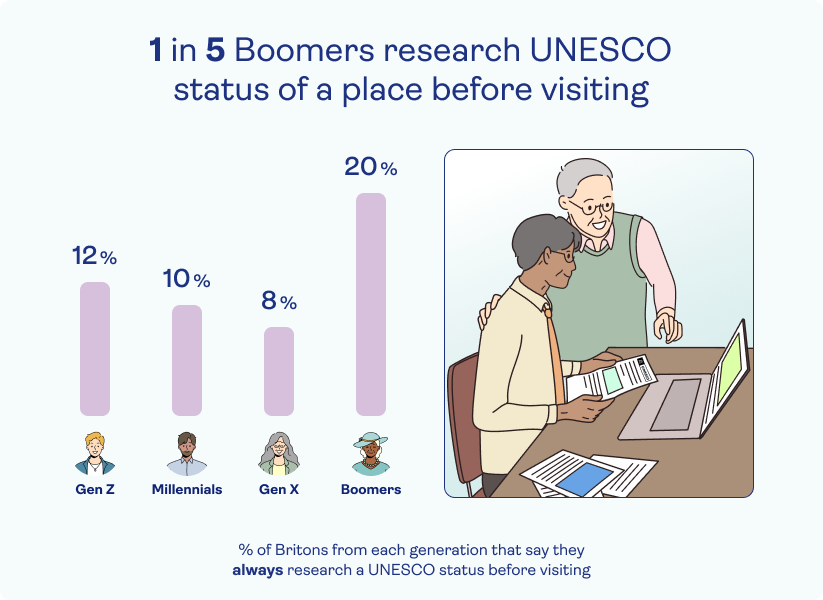
Baby Boomers were the most likely to say they always research why a site was listed (20%), compared with 12% of Gen Z, 10% of Millennials and 8% of Gen X. Many more say they research only sometimes.
Professor Mike Robinson said: “The more information and education you can give people in advance, the better. Very often, visitors are told about the history of a place, but not why it is World Heritage listed – and understanding that helps people appreciate it properly.”
Dr Catherine Roberts also advises travellers: “Do your research: find out about local customs and beliefs, and try to avoid behaviour that might seem careless. This is a great way of seeing heritage sites through the eyes of the local community. Take time to read up on everyday behaviour, local and national history and maybe even learn a few key phrases – especially thank you! This goes a long way.”
How to visit UNESCO World Heritage Sites as a responsible tourist
As UNESCO World Heritage Sites hold so much significance, being a responsible tourist can help to protect these sites. Not only that, but tourists can also be fined for irresponsible behaviour, such as vandalism, accessing unauthorised areas, or eating and drinking in certain places – even if it’s not on purpose.
Dr Catherine Roberts shared some advice for responsibly visiting a UNESCO World Heritage Site.
She commented: “World heritage sites are so diverse – from splendid monuments, bridges and buildings to sites of tragedy and landscapes of outstanding environmental value. So, it’s difficult to give a single piece of guidance about what we should all stop doing at these remarkable locations, although it’s essential we stop leaving litter and taking ‘souvenirs’. Leave nothing and take nothing; our goal is to leave these special places as we find them.
“One thing all heritage sites have in common, though, is vulnerability to damage and decay that might mean serious consequences for their preservation. So, I would say: please stop bypassing the guidelines and requests made by world heritage sites. The managers of these locations have specialist knowledge about preventing damage and how best to keep them safe for future generations. Try not to treat those guidelines as an inconvenience – it’s your chance to help safeguard the world’s heritage, and show respect for humanity’s shared inheritance and history.”
Exploring UNESCO-listed sites with Saga Holidays
Saga Holidays is known for our off-peak and shoulder-season travel, which can allow travellers to visit UNESCO World Heritage Sites when they’re typically quieter. This can help ease pressure on popular destinations, while making visits feel calmer, more comfortable and more enjoyable.
If you are feeling inspired and motivated to visit a UNESCO World Heritage Site for yourself, we offer a range of tours that offer the chance to observe and visit a range of sites across Europe and the rest of the world.
Treasures of Moorish Spain
)
Baeza
This escorted tour through southern Spain includes Cádiz, Seville, Córdoba and Granada, along with the UNESCO-listed towns of Baeza and Úbeda.
More information: Treasures of Moorish Spain
Adriatic Coastal Explorer
)
Šibenik Cathedral
Cruise Croatia’s north Dalmatian coast, stepping ashore to explore historic cities and coastal highlights. This itinerary includes visits to UNESCO-listed treasures including Šibenik Cathedral, the Historical Complex of Split with the Palace of Diocletian, and the Historic City of Trogir.
More information: Adriatic Coastal Explorer
Splendours of Southern Italy and Sicily
)
Trulli houses, Alberobello
This escorted tour showcases the rich history, distinctive architecture and dramatic landscapes of southern Italy and Sicily, with visits to UNESCO-listed highlights including the trulli of Alberobello, the Sassi and the Park of the Rupestrian Churches of Matera, and Mount Etna.
More information: Splendours of Southern Italy and Sicily
Archaeology in Cyprus
)
Tombs of the Kings, Pahpos
Discover the history, culture and natural beauty of Cyprus on this special interest holiday, which includes time in Paphos, home to fascinating archaeological treasures such as the UNESCO-listed Tombs of the Kings.
More information: Archaeology in Cyprus
Methodology
A survey of 813 Britons was conducted to uncover their understanding and perceptions of UNESCO World Heritage Sites.
Recent articles
Published
)
Important information
§Travel insurance is underwritten by Astrenska Insurance Limited, subject to medical screening. A price reduction will be applied if the included travel insurance is not required. Pre-departure cancellation cover (cancellation rights) is provided by Saga and is only available when taking out the included insurance. Read more